How to Negotiate Salary After a Job Offer in 2026: 6 Steps and Email Examples
A practical guide to negotiating salary after a job offer, reviewing benefits, making a researched counteroffer and confirming the final written terms.
How do you negotiate salary after receiving a job offer in 2026? Begin by thanking the employer, requesting the full written offer, comparing it with credible salary information for your role and location, and choosing a reasonable request supported by your skills. Ask whether the proposed compensation is flexible before you formally accept. If you agree on new terms, request an updated written offer.
A job offer is an important milestone, but it does not automatically mean you should accept every term on the spot. Salary, benefits, schedule, location, learning opportunities and personal responsibilities all matter. A professional negotiation is not an argument: it is a conversation to understand whether you and the employer can agree on conditions that work for both sides.
This practical JovoJob guide covers salary research, a six-step negotiation process, sample email and phone wording, benefits you might discuss, when not to negotiate, and how to protect yourself from fake offers. The advice draws on university career centers, including the University of Maryland, the University of Kansas, and the University of Michigan. Hiring customs and employment law vary by country, so treat the examples as guidance rather than a guarantee.
To negotiate salary professionally, focus on the actual job responsibilities, a reasonable market comparison and your verified experience. Never promise an outcome or manufacture numbers.
First, understand what your job offer really includes
Before negotiating, carefully examine the proposed employment terms. The most visible number is usually base salary, but it is only one part of compensation. Look at the stated currency, whether pay is hourly, monthly or annual, the normal working hours, the location and whether the employer includes additional benefits or variable pay.
For example, a role offering a larger headline salary may also require an expensive commute or relocation. Another role with a slightly lower base may include paid leave, healthcare support, professional training or predictable working hours. These are different types of value, not interchangeable promises. Compare each element using the actual written conditions rather than an impression from the interview.
Request the full offer in writing
If the offer arrives by telephone, thank the recruiter and ask for the written details and response deadline. The University of Maryland Career Center recommends reviewing the whole package, seeking clarity and understanding the deadline before committing. Written information helps prevent confusion about salary, working conditions and the start date.
Read clauses concerning probation, shifts, commissions, training requirements, remote work, employment status, relocation and any conditions that must be satisfied before starting. If a term is unfamiliar, ask a specific question. For contracts involving another country, check applicable law and the employer's legal identity; seek qualified local advice when the legal implications are unclear.
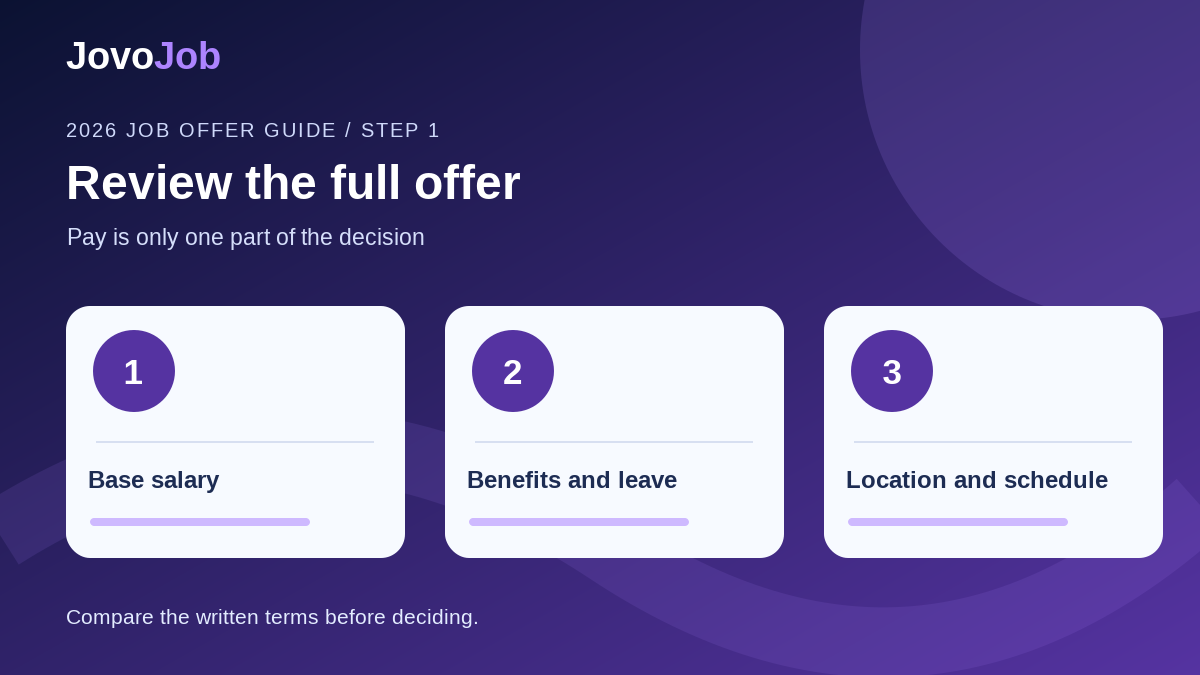
Illustration 1: Review base salary, benefits and location or schedule together, rather than making a decision from one number.
How to research a fair salary for your role and location
A defensible counteroffer begins with evidence. Compare positions that resemble the actual role in duties, responsibility, location, industry and level. Do not compare an entry-level position with a senior management role simply because the titles share a word. Salary figures may be reported in different currencies, pay periods or tax contexts, so keep the comparison consistent.
Find at least two independent sources
Start with vacancies that publicly disclose compensation. Review the same employer's stated range if available, then compare equivalent job postings at other organizations. Research published labor-market information where possible, and talk to trusted professionals familiar with the occupation. The University of Kansas Career Center recommends looking at job postings, competitors, company information and professional conversations.
For United States roles, the Bureau of Labor Statistics Occupational Employment and Wage Statistics provides occupation and location estimates. Those statistics describe particular labor markets and periods: they do not automatically translate into an offer for a specific company or an overseas destination. In other countries, look for the relevant national statistical office, reliable salary surveys or official employer salary bands.
Turn research into a realistic target
Write down three private reference points: the minimum terms you would realistically accept, the target that you can justify, and the range you found for similar work. These are planning tools, not universal percentages. The difference between your target and the first offer should have a reason: directly relevant experience, skills, responsibilities, local pay evidence, or the total package.
A hypothetical example makes the method clear: imagine an employer offers a monthly salary of 3,000 units in a fictional currency, and well-matched reliable listings suggest higher pay for comparable responsibilities. You might request a specific revised figure supported by your experience. The numbers here are only a teaching example; they are not market data and should never be copied into a real negotiation without research.
Six steps to negotiate salary after a job offer
The easiest way to negotiate salary is to prepare the facts, ask clearly and keep the conversation collaborative.
Step 1 — Express appreciation and enthusiasm
Open by thanking the recruiter or hiring manager for the opportunity. If you are genuinely interested, say so. Avoid starting with disappointment or an ultimatum. This keeps the discussion focused on reaching a workable agreement.
Step 2 — Clarify the written offer and deadline
Confirm the title, salary basis, benefits, start date and any conditions. If you need time to review, ask when the employer expects your answer. Request an extension well before the deadline if necessary; the employer may accept or decline it.
Step 3 — Prepare a specific and supported request
State what you are asking for, whether that is a revised base salary, a particular benefit or another working condition. Connect the request to relevant skills and credible pay evidence. The University of Michigan Career Center encourages candidates to do research and make clear, reasonable requests rather than relying on general claims of deserving more.
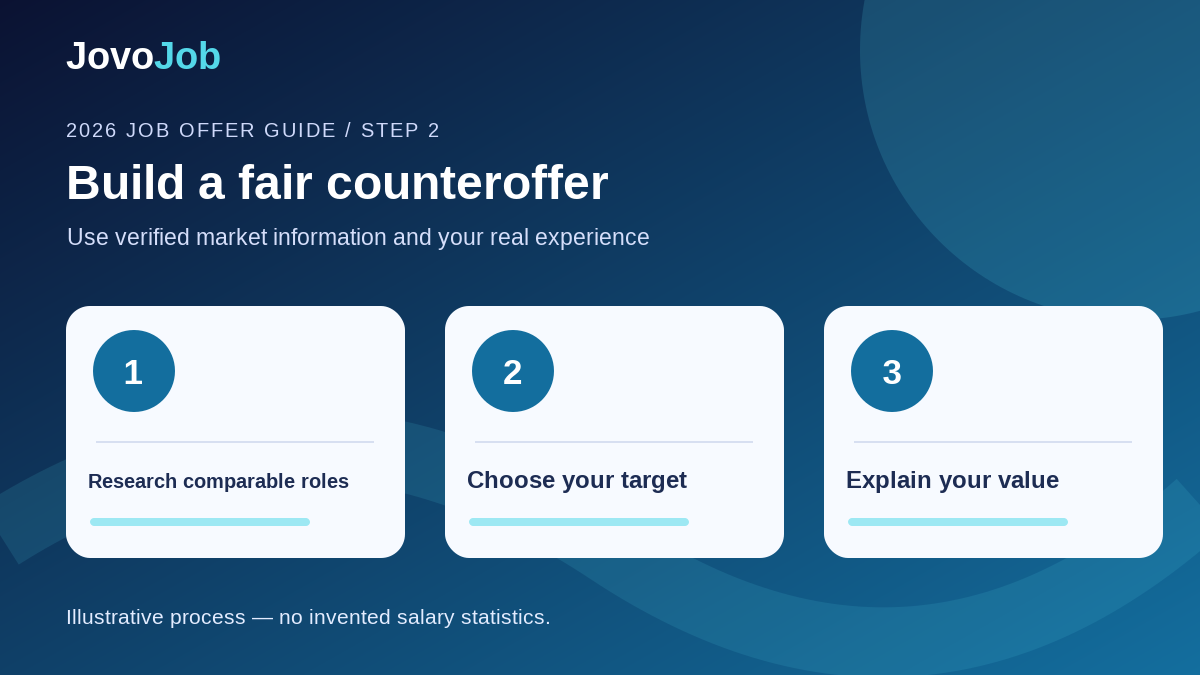
Illustration 2: Build a respectful counteroffer from comparable roles, your target and the specific value you can bring.
Step 4 — Ask whether there is flexibility
A simple question can begin the discussion: “Thank you for the offer. Is there flexibility in the starting salary?” When the recruiter invites discussion, make your specific case. You can speak by phone and then summarize the result by email. Keep the tone calm, and listen to the employer's explanation of compensation limits.
Step 5 — Consider the complete package
If base pay is fixed, you may be able to discuss the start date, additional leave, working pattern, professional development or relocation support. Not every item is negotiable, and some employers have standardized packages. KU's guidance and Boston College's career advice both note the value of evaluating benefits and other conditions.
Step 6 — Confirm everything in writing
After reaching agreement, request a revised offer or written confirmation reflecting the accepted terms. Check it carefully before responding. If you accept, follow the specified procedure and reply within the agreed deadline. A friendly email summary alone does not replace any formal contract or documentation required by the employer.
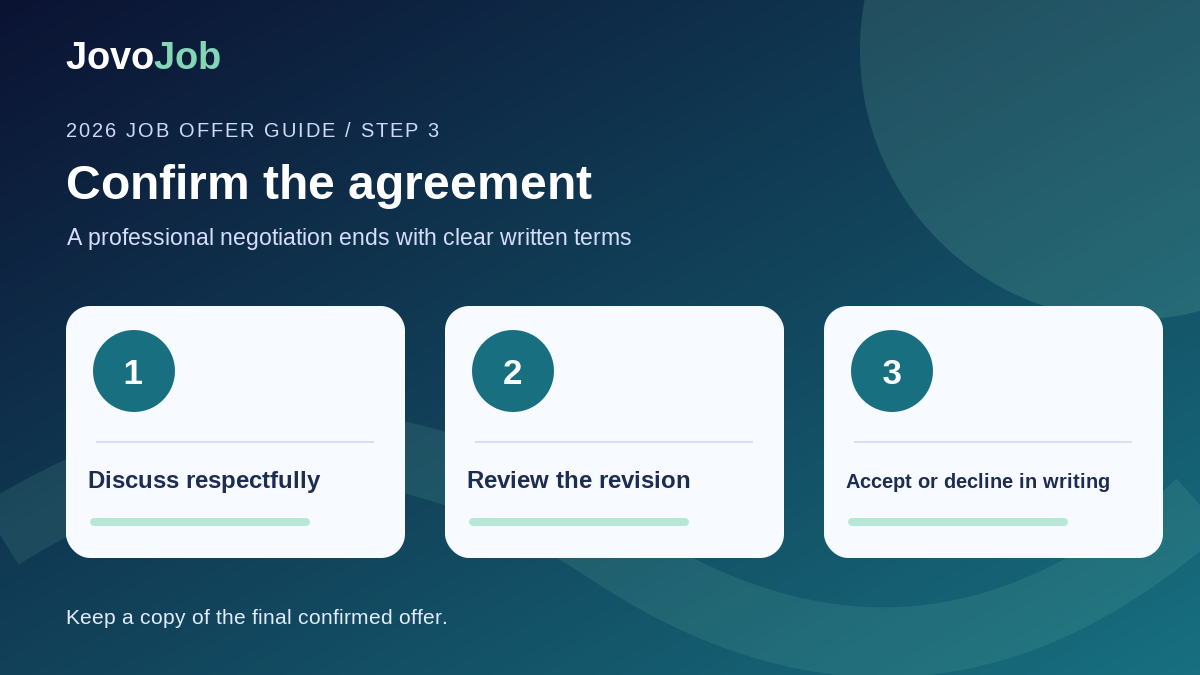
Illustration 3: A negotiation is not complete until the terms you agree to are clearly documented.
Example: a polite salary negotiation email
You can adapt this fictional email without copying any salary figure or qualification that does not apply to you.
Subject: Job Offer Discussion — [Position Title]
Dear [Hiring Manager],
Thank you for offering me the [position] role. I appreciate the opportunity and am excited about the work your team is doing.
After reviewing the responsibilities and researching compensation for comparable roles in [location], I wanted to ask whether there is flexibility in the starting salary. Based on my experience in [relevant skill or project] and the requirements of the position, I was hoping we could discuss [specific target or reasonable range].
I would be happy to discuss the details and understand what may be possible. Thank you for your consideration.
Best regards,
[Your Name]
Replace the placeholders with facts. Do not claim another offer exists unless it does, and do not invent salary research. If the position has a fixed pay scale, the employer may simply explain that negotiation is not available.
What to say in a phone conversation
Try: “Thank you for offering me the position. I'm interested in joining the team. I've reviewed the responsibilities and compared similar roles in this area. Would it be possible to discuss a starting salary closer to [your evidence-based target]?” Then stop and listen. A conversation works better when both parties have room to respond.
If the company says no
Thank the recruiter for clarifying the position. You can ask whether other parts of the package are flexible or whether there is a defined pay-review process. If the offer still does not meet your essential needs, it may be appropriate to decline respectfully. Conversely, if it is fair and fits your goals, accepting without further negotiation can be reasonable.
What else can you negotiate besides salary?
Options depend on the employer and local rules. Potential discussion points include the starting date, work schedule, hybrid or remote arrangement, vacation allowance, professional development, signing bonus, commuting support or relocation assistance. Ask whether any proposed benefit is permanent, conditional, taxable or subject to written policy.
Consider which terms would actually improve your situation. For a worker changing cities, relocation support might matter. For someone returning to education, predictable hours or training may be more useful. A candidate who prioritizes long-term growth could ask about professional development and review procedures. Treat promises as tentative until confirmed.
Compare two offers systematically
Create a simple comparison using base salary, working hours, location, commuting or housing costs, benefits, role responsibilities, learning opportunities, employer stability and contract conditions. A larger nominal salary does not necessarily mean a better financial outcome after taxes, transport and other expenses.
For international offers, confirm salary currency, gross or net basis, cost of living, employment authorization and relocation conditions using official sources. A job offer does not by itself grant permission to work abroad. Our JovoJob country-search and legal migration guide explains why employer discovery and visa permission are separate steps.
When negotiating may not be appropriate
Some roles use published salary grades, collective agreements or standardized entry-level packages, leaving little or no room to negotiate. DePaul's Career Center notes that not every entry-level compensation package is negotiable. The University of California, Riverside also highlights highly structured pay systems.
Do not delay a time-sensitive offer without communicating. Avoid threats, unverified market claims or asking for a raise after signing as though the previous terms were not accepted. A respectful inquiry about flexibility is different from insisting that every employer change its policy.
Protect yourself from fake job offers
Before negotiating compensation, verify that the employer and offer are genuine. An unsolicited recruiter asking you to send money to secure employment or unlock wages is a serious warning sign. The U.S. Federal Trade Commission's April 2026 warning describes fake recruiters who use plausible job messages to extract payments. Read our fake job offer safety guide and confirm the vacancy on the employer's official website.
Frequently asked questions about salary negotiation
Is it okay to negotiate after receiving a job offer?
Often, yes. Many career centers recommend discussing compensation after receiving the offer but before formally accepting. Some employers and sectors have fixed pay policies, so first ask whether the terms are flexible.
Should I negotiate over email or phone?
Either can work. A phone call may be useful for discussion; email provides a clear written record. Follow the employer's preferred process and request written confirmation of any final agreement.
How much more salary should I ask for?
There is no universal percentage that is appropriate for every role or country. Base your target on comparable work, location, skills, level and total compensation. Do not treat an internet rule of thumb as verified salary data.
Can I negotiate my first job offer?
You can ask respectfully whether there is flexibility, but entry-level packages may be standardized. Research before requesting changes, and consider the full value of the opportunity.
What if I already accepted the offer?
Once you have accepted, assume the agreed terms matter. If new circumstances arise, you can communicate transparently, but an employer does not have to reopen negotiations. Employment contracts and local law may govern what can be changed.
Should I mention competing offers?
Only mention other offers if they are real and you are comfortable discussing them honestly. Avoid ultimatums and never fabricate an employer's name, deadline or salary.
Should I ask for an updated offer letter?
Yes, where the employer normally provides written offers. Check that changes to salary, start date or benefits are accurately recorded before accepting. The UW–Madison Career Center recommends getting negotiated terms in writing.
When you negotiate salary, a respectful explanation and written confirmation matter more than a memorized script.
Final checklist: negotiate professionally and decide confidently
- Verify the job offer and employer independently.
- Get the terms and decision deadline in writing.
- Research genuinely comparable pay by role and location.
- Consider benefits, work conditions, taxes and cost of living.
- Identify a realistic target and your essential needs.
- Ask respectfully about flexibility and listen to the response.
- Confirm the revised terms before accepting or declining.
Your next career move should be based on clear information, not pressure. Use JovoJob Career Agent to help organize your job preparation, and explore our interview introduction guide if you are still preparing for the hiring process. No tool or negotiation script guarantees a higher salary or a job offer.
Editorial sources and methodology
Prepared for JovoJob on November 10, 2026. Guidance was checked against University of Maryland — Offers & Salary Negotiation, University of Kansas — Salary Negotiation, University of Michigan — Evaluating and Negotiating Offers, UW–Madison — Evaluating & Negotiating Offers, Boston College — Evaluating an Offer and FTC — Job Offer Scam Warning. Sample scripts and numerical illustrations are original, fictional teaching examples. No measured success rates or unverifiable salary statistics are presented. Employment rights, contract requirements and pay practices vary by jurisdiction.