Fake Job Offers in 2026: 12 Red Flags and How to Verify Recruiters
Learn to spot fake job offers in 2026 with 12 practical warning signs, a seven-step recruiter check, scam examples and safe next steps.
How can you spot fake job offers in 2026 before losing money or exposing personal information? Start by verifying the employer through an independent source, reading the actual job description, and refusing requests to pay for a job. A professional logo, polished message, recruiter profile or even a video interview does not prove that an offer is genuine.
Fake job offers can arrive by email, SMS, messaging apps, social media or job boards. A scammer may impersonate a familiar company, offer flexible remote work or promise unusually quick earnings. According to the U.S. Federal Trade Commission's April 2026 warning, some bogus recruiters now send vague remote-job texts asking recipients to reply with a single word, then invent reasons the candidate must send money. The FBI's Internet Crime Complaint Center has also described work-from-home task schemes that demand cryptocurrency deposits.
This practical guide covers 12 warning signs of fake job offers, a straightforward recruiter-verification checklist, examples of suspicious messages, and steps to take if you have already interacted with a scammer. Warning signs are clues, not an automatic verdict about every unusual hiring process. The safest decision comes from checking the evidence independently.
What are fake job offers?
A fake job offer presents employment that does not exist, impersonates a legitimate employer, or misrepresents a so-called business opportunity to obtain money, personal data or unpaid work. Some scams start with a job posting; others begin with an unsolicited message from someone claiming to recruit for a recognizable company. A real company name or copied vacancy description can appear in a fraudulent advertisement.
Recruitment methods differ across countries and industries. Some legitimate recruiters approach candidates who have not applied, and some small businesses use personal email accounts. These details alone do not prove fraud. But payment requests, financial transfers, demands for sensitive information before hiring and unverifiable hiring identities are much stronger signals. Indeed's June 2026 job-scam guide highlights unexpected offers, requests for banking information and unrealistic claims as reasons to investigate.
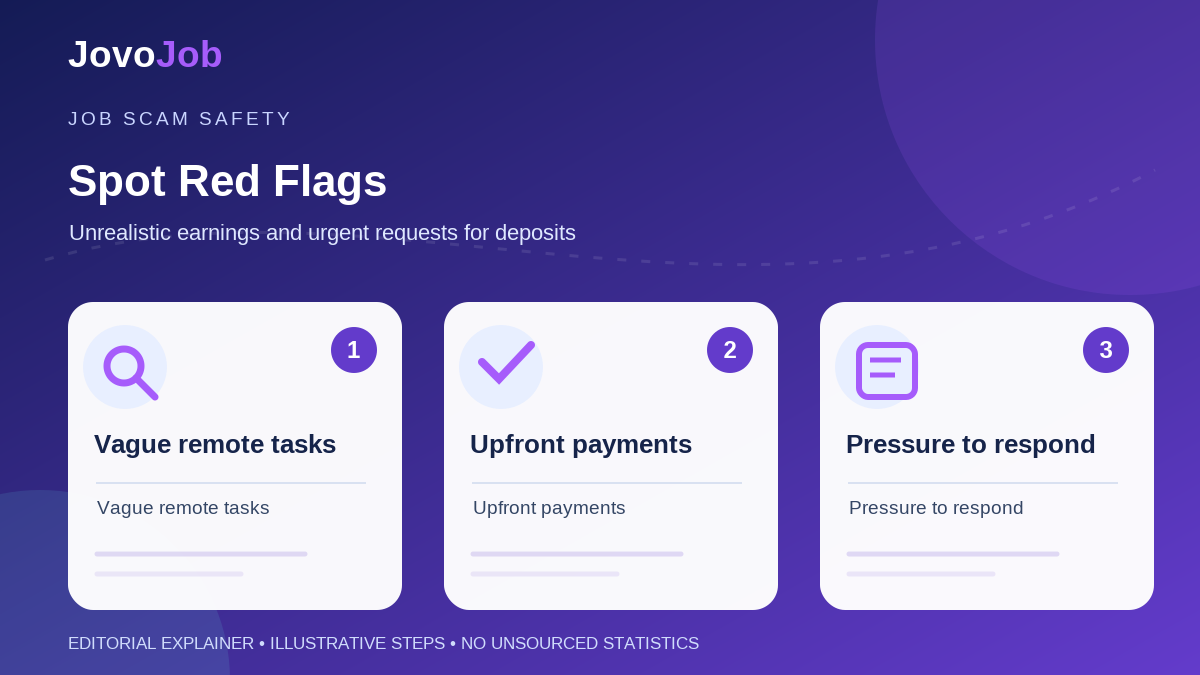
Fake job offers in 2026: 12 red flags to recognize
1. An unexpected offer describes almost no real work
A message promising a "remote position" or "online assessor" role without a clear employer, responsibilities, qualifications or hiring process deserves scrutiny. The FTC describes fake recruiters who emphasize daily or weekly earnings while offering few details. If the only instruction is to reply "YES" or "INTERESTED," do not treat the message as a verified opening. Find the company's real website yourself before engaging.
2. You are promised high earnings for minimal effort
Be skeptical of a supposedly easy job that pays far above comparable roles for a few minutes of clicking each day. Some genuine specialized jobs pay well, and advertised salaries vary by market, so high pay alone is not proof of fraud. The concern grows when unusually high returns are combined with vague tasks, no qualifications and immediate pressure. Compare the stated work with real listings and ask what the employee is actually expected to produce.
3. The recruiter asks you to pay for the job
A request for a fee to activate your account, secure an interview, release wages or guarantee a position is an especially serious red flag. The FTC's February 2026 side-hustle guidance says legitimate jobs do not require people to pay simply to get employed or receive their pay. Different countries may have lawful, optional training or professional licensing expenses, but such situations are not the same as sending an unfamiliar recruiter money to unlock a supposed job.
4. You must deposit cryptocurrency to unlock tasks or earnings
In a typical task scam, a website shows fictional earnings from clicking, rating or "optimizing" products. The balance grows until the platform claims you must deposit your own funds to finish a task or withdraw earnings. The FBI and FTC warn about this pattern. Do not send cryptocurrency or bank transfers to an alleged employer in exchange for access to your own wages.
5. You receive a check and are told to return part of the money
An alleged employer may send a check to "buy home-office equipment" and direct you to return excess money or pay a particular vendor. The check may appear available in your bank before the bank determines that it is fraudulent. The FTC warns that fake-check arrangements can leave victims responsible for the funds they transferred. Do not forward part of a check's value or buy gift cards for a stranger who claims to be hiring.
6. A remote "job" asks you to receive and resend packages
A reshipping scam may describe you as a delivery coordinator or quality-control assistant. Your task is to accept parcels at home, remove labels or packaging and forward the items to another address. The FTC's December 2025 advisory warns that the parcels can involve goods purchased with stolen payment information and that workers may never receive the promised salary. Do not accept an unfamiliar package-reshipping role as an ordinary remote job.
7. The hiring process becomes unusually urgent
Scammers may claim that a vacancy will disappear in an hour or that paperwork and payment must be completed immediately. Real employers can have genuine deadlines, but reasonable verification should not be treated as disobedience. If a recruiter refuses to let you confirm the company's identity, read a contract or contact HR independently, stop and investigate. Urgency is particularly suspicious when money or identity documents are involved.
8. The contact address does not match the claimed company
Look closely at the sender's email domain. A message claiming to represent a major company but coming from a random personal address or a confusing look-alike domain deserves independent checking. LinkedIn's scam guidance identifies mismatched domains as a warning sign. However, staffing agencies may legitimately recruit on behalf of clients and use their own domains. Confirm who employs the recruiter by contacting the company through a separately found official number or website.
9. The vacancy cannot be verified independently
Search the company's real careers page for the job title, requisition number and location. The FTC notes that criminals sometimes copy or alter real employers' listings. The absence of a role on a careers page is not always conclusive: agencies and confidential searches do exist. But if the company cannot confirm any relationship with the recruiter, or if the listing sends you to a suspicious payment form, do not proceed.
10. Sensitive documents are demanded before a genuine hiring step
Identity documents and banking details may eventually be required for lawful onboarding in some countries. The problem is a stranger demanding them before the employer or hiring process is verified. The FTC warns about fake recruiters requesting financial information in the name of payroll setup. Never send passwords, one-time codes, payment-card data or banking credentials to a recruiter. Only provide necessary identity information through a confirmed employer's legitimate, secure process when there is a genuine reason.
11. You are "hired" without any credible assessment
Some jobs have simple selection processes, so a short interview is not by itself fraudulent. But a high-paying offer arriving immediately after a text-only exchange, followed by a request for money or personal documents, should make you suspicious. Verify that the recruiter really works with the employer, ask for a written role description and independently confirm the onboarding channel. Do not confuse a convincing offer letter or video-call background with authentication.
12. You are pressured to move to a private chat or an unfamiliar link
Moving from a job platform to email, telephone or messaging is not inherently illegitimate; companies use different channels. The red flag is pressure to leave a platform immediately, refuse independent checks or click an unknown login link. LinkedIn's job-safety guidance recommends watching for rapid off-platform pressure and verifying a recruiter's profile and professional identity. When in doubt, use the official contact details you found independently.
How to verify a recruiter and a job offer in seven steps
Step 1: Find the company independently
Open a new browser tab and type the organization's official website yourself. Do not rely only on the link in the recruiter's message. Check its careers section, public company details and hiring contact information. If you cannot confirm that the employer exists, pause before sharing any personal details.
Step 2: Compare the job description
Match the title, location, schedule, required skills and application procedure with the official listing if one is available. Check the job reference number. Be careful when a message offers one role but redirects you to an unrelated task platform or deposit page. A mismatch is a reason to ask the employer directly.
Step 3: Verify the recruiter with the company
Look for professional history, but do not assume that a social profile, logo or verification-looking graphic proves identity. Contact an official HR or careers address obtained independently and ask whether the recruiter or agency is authorized. Keep this question factual and do not send unnecessary personal documents.
Step 4: Search for independent complaints
Search for the company name and recruiter's name alongside words such as "scam," "complaint," "review" or your language's equivalent. A single negative review is not proof; similarly, perfect reviews may be fabricated. Look for consistent reports and official advisories. The FTC recommends this kind of independent research.
Step 5: Check every payment request
Ask yourself whether the "employer" wants you to transfer money, buy cryptocurrency, purchase gift cards, return part of a check or pay to access wages. These are major warning signs. Do not use a payment method merely because the sender calls it a "verification" or "account activation" requirement.
Step 6: Confirm the real application and interview channel
Where possible, apply through a verified company portal. For agency-managed roles, verify the staffing firm's legitimacy and relationship to the employer. A real interview should allow you to discuss actual work, responsibilities, supervision and compensation. You should be able to ask reasonable questions before signing or sharing sensitive onboarding information.
Step 7: Keep records and decide without pressure
Save the job posting, date, sender contact and written terms while avoiding downloads from suspicious sources. If anything remains unverified, do not submit payment or confidential data. A trustworthy opportunity should withstand ordinary due diligence. You can continue looking for other jobs while investigating this one.
Fake job offer examples: compare the message with a safer response
Example A: The instant remote-task invitation
"Hello! Your profile was selected for online product optimization. Earn $200 daily, no experience needed. Reply YES now and pay a small activation deposit to begin."
Why it raises concern: the sender offers little actual job detail, promises quick earnings and requests a deposit. The message resembles patterns described in FTC and FBI task-scam warnings. Safer response: do not reply, pay or click unknown links; research the employer through a separate source and report the suspicious message if appropriate.
Example B: The counterfeit equipment check
"Congratulations, you are hired. Deposit this check for home-office equipment and send the remaining funds to our approved supplier today."
Why it raises concern: the request combines a claimed job offer with a payment reversal or vendor transfer. Safer response: do not send funds; independently contact the alleged employer and speak to your bank before attempting any transaction. This is a fictional example for education, not an actual offer.
Example C: A legitimate-looking agency contact
"I'm contacting you on behalf of a retail client. The role is based in your city and requires two years of inventory experience. You can review the job description and confirm our agency details on our website."
How to assess it: an unsolicited approach can be legitimate. The specific role, verifiable agency and absence of upfront payments are better signs than vague promises. Still check the firm's official website, confirm its relationship to the client and read the actual job description before sending documents.
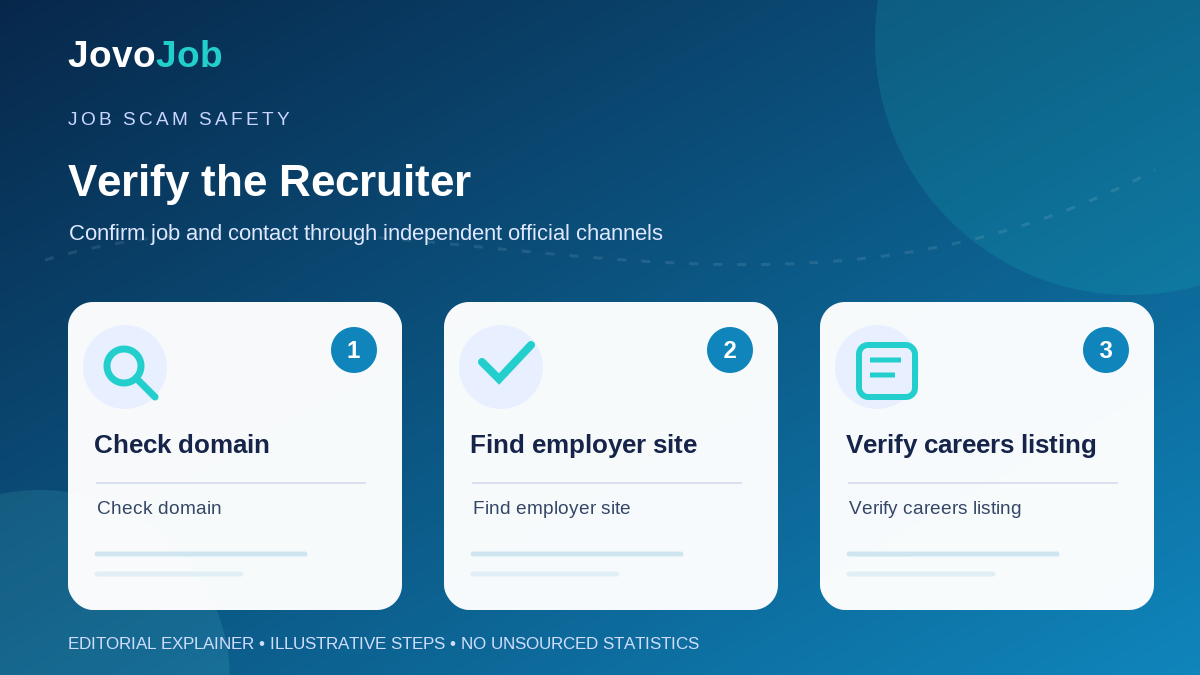
How to search for legitimate jobs while avoiding fake job offers
Use several independent channels: verified company careers pages, established job boards, reputable staffing firms and credible professional networks. Do not rely on a message from one anonymous account. On JovoNet, professional discussions may help you discover people and employers, but community posts do not constitute verified job offers. Our guide to job networking on JovoNet explains how to connect and research responsibly.
Once a vacancy is confirmed, prepare a clear CV, follow the employer's application instructions and track each contact. JovoJob's Career Agent can help organize parts of that process. For application quality, explore the ATS-friendly resume guide and cover-letter examples. These tools can support preparation, but they cannot certify that every externally advertised job is legitimate or promise a hiring decision.
What to do if you already responded to a fake recruiter
If you only replied: stop engaging, do not open new links or files, and block/report the account where appropriate. Keep useful records of the encounter without sharing the scam publicly in a way that exposes personal information.
If you sent money: contact your bank, card provider or payment service immediately, describe the suspected fraud and ask whether a reversal or other protective action is possible. Do not pay an additional "recovery fee" to someone who says they can retrieve lost funds. Recovery is not guaranteed, so act promptly and document transactions.
If you shared a password or sensitive identity information: change exposed passwords using the real service website, enable multi-factor authentication where available and contact the relevant financial provider. Follow locally applicable identity-theft and fraud-reporting guidance. In the United States, FTC recovery guidance, IdentityTheft.gov and ReportFraud.ftc.gov provide official resources. Outside the United States, contact local consumer-protection or law-enforcement authorities.
If you saw the posting on a platform: report the profile or advertisement to that service and provide the relevant details without spreading potentially dangerous links. Reporting a suspicious post helps the platform investigate; it does not automatically establish that the account is fraudulent.
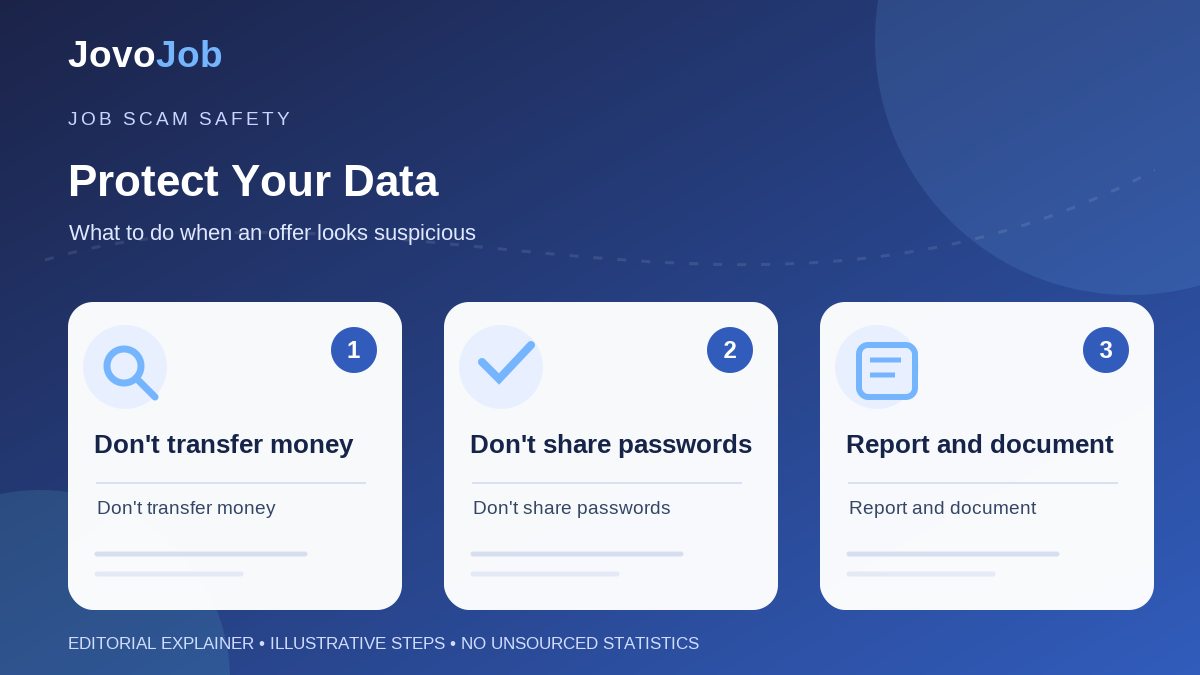
Fake job offers: a 60-second safety checklist
- Did I find the employer's official website independently?
- Can I verify the job description or recruitment agency through a trustworthy source?
- Does the contact identity make sense, including the email domain?
- Is the proposed work specific and reasonably consistent with the pay?
- Is anyone asking me for upfront money, cryptocurrency, gift cards or a payment return?
- Am I being pressured to disclose sensitive information before verifying the job?
- Have I checked for independent complaints or official warnings?
- Would I feel comfortable explaining the full process to someone I trust before proceeding?
If you cannot answer the first two questions and one of the payment or privacy warnings is present, do not proceed until you have reliable confirmation.
Frequently asked questions about fake job offers
How do I know if a job offer is fake?
Look for combinations of warning signs: unverifiable company identity, vague duties, unusually high promised pay, requests for payment or premature demands for financial information. Verify the offer through the employer's independently located official contact details.
Can a fake recruiter use a real company's name?
Yes. Criminals can impersonate recognized employers, copy job descriptions and create convincing profiles. The real company's name is not proof that the sender is authorized.
Are all WhatsApp or Telegram job offers scams?
No single messaging app proves a scam. Some genuine employers and staffing agencies use messaging services, depending on the country and hiring process. Unexpected generic messages, secrecy, pressure, payment requests and unverifiable identities make an offer much more suspicious.
Is it normal to pay for training before starting a job?
Some occupations involve independently purchased education or licensing, but sending an unknown recruiter money to secure a job, activate tasks or unlock wages is a serious warning sign. Confirm any genuine professional requirements through the relevant official institution.
Can a real-looking offer letter be fraudulent?
Yes. Logos, signatures, PDFs and even video calls can be fabricated or impersonated. Verify the sender and role with the employer rather than judging authenticity from presentation alone.
What if I already shared my CV?
A typical CV may contain contact information and employment history. Stop sending additional details, watch for impersonation or suspicious follow-up messages, and act quickly if the file also exposed sensitive IDs, account details or passwords. Seek advice from an appropriate local authority if necessary.
Does a job posted on JovoNet or another social network mean it is verified?
No. A community post should be treated as information to investigate. Check the original employer's website and actual application process before applying or sharing sensitive documents.
Final advice: verify first, then apply with confidence
The best way to avoid fake job offers in 2026 is to slow down when a message combines excitement with pressure. A legitimate opportunity should provide enough information for you to check the role, recruiter and application process independently. Never send money merely to unlock a job or a supposed paycheck. Continue a thoughtful job search using verified sources and honest applications.
Explore JovoJob's practical job-search guide, review your qualifications and use Career Agent to organize genuine opportunities. Protecting your privacy is part of building a sustainable career—not an obstacle to it.
Sources and editorial methodology
Prepared for JovoJob in November 2026. This original guide draws on the FTC (April 2026): Fake Job-Offer Texts, FTC (February 2026): Side-Hustle Scams, FTC (December 2025): Reshipping Scams, FTC (August 2025): Task Scams, FBI IC3: Work-From-Home Scams, LinkedIn: Recognize and Report Scams, and Indeed: How to Know if a Job Is a Scam (updated June 2026). Sample recruiter messages above are fictional and included for teaching. Reporting systems and laws vary by country; this article does not provide legal or financial advice or identify real individuals as scammers.