How to Answer Tell Me About Yourself in a Job Interview (2026): 7 Examples
Learn how to answer Tell Me About Yourself in a job interview with a simple Present–Past–Future formula, seven practical examples and tips for nervous candidates.
How do you answer “Tell me about yourself” in a job interview in 2026? Give the interviewer a short, relevant professional story: where you are now, what experience prepared you for the role, and why you want this opportunity next. Aim for approximately 60–90 seconds as a practical starting point, then adjust to the interviewer and role. A strong answer is a conversation opener—not your entire life story or a line-by-line reading of your CV.
University career centers consistently recommend a focused answer connected to the job: UW–Madison's Career Center suggests a concise professional story of two minutes or less, Yale's Office of Career Strategy emphasizes relevant background and interest, and Brandeis University explains the Present–Past–Future method. This guide turns those principles into an editable formula, seven original examples, mistakes to avoid and a realistic practice plan.
What does “Tell me about yourself” mean in a job interview?
Interviewers usually want a clear introduction to the qualifications you think matter most for the position. The question can reveal how you select relevant facts, communicate and connect your experience to the employer's needs. It is not typically a request for your family background, every school you attended or a complete biography.
For a customer-service vacancy, emphasize communication, handling questions and resolving problems. For a warehouse role, emphasize accuracy, stock control and coordination. For an entry-level job, use projects, volunteering and coursework as evidence when they genuinely apply. The facts change, but the goal remains the same: show a credible connection between your background and the work.
The same opening can appear as “Walk me through your resume,” “Tell us about your background,” or “How did you get interested in this field?” The best answer should still fit the interviewer's wording. If they ask specifically about a career change or a project, adapt your emphasis rather than reciting a memorized script.
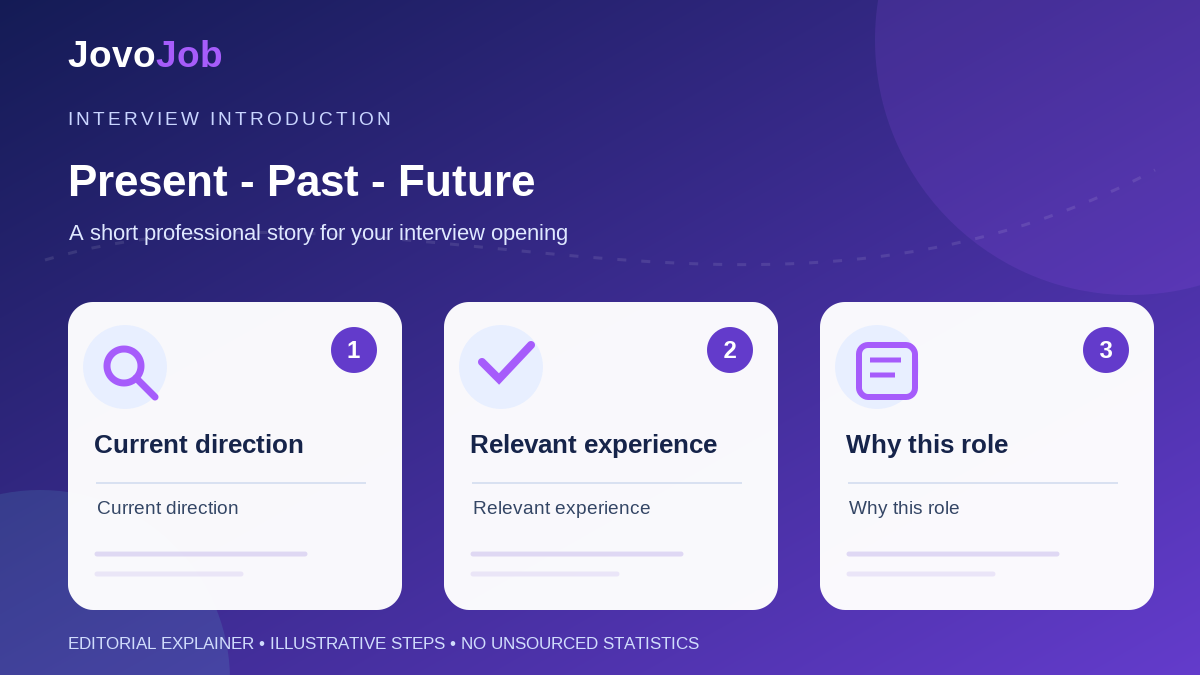
The easy Present–Past–Future formula for a job interview
1. Present: say where you are professionally
Start with your current role, recent qualification, training or relevant project. In one or two sentences, identify the skills or responsibilities that matter for this vacancy. If you are unemployed, you can introduce your most relevant recent work or current professional direction without apologizing. If you are a student, mention the course or project most connected to the role.
2. Past: choose one or two relevant examples
Briefly explain what prepared you for this opportunity: a previous job, internship, volunteer project, assignment or transition. Select evidence that supports the employer's priorities. If you can verify a result, include it; if you cannot, describe your responsibility and what you learned. Avoid inventing figures or giving a list of every task you have ever done.
3. Future: explain why this role fits your next step
Finish with a reason the advertised role interests you. Make the connection specific: perhaps the employer works with a customer group you know, uses a skill you have developed, or offers the kind of responsibilities you want to pursue. Do not claim a personal passion you do not genuinely feel. A simple, credible explanation is more effective than exaggerated flattery.
Editable answer template:
“I'm currently [current role or recent training], where I focus on [relevant skill or responsibility]. Previously, I [one example of relevant work, project or achievement], which helped me develop [a skill the job requires]. I'm interested in this [job title] position because [specific connection to the role], and I'd like to bring [your relevant contribution] to the team.”
This is an example framework, not a script you must memorize. UW–Madison and Brandeis both describe the Present–Past–Future structure as a useful way to keep this answer organized.
How long should your “Tell me about yourself” answer be?
A practical target is about one minute, often around 60–90 seconds. That is long enough to establish your role, one or two relevant examples and a reason for applying, but short enough to leave room for follow-up questions. Mississippi State University's Career Center suggests roughly 60–90 seconds; Yale recommends keeping a professional story under two minutes.
The exact timing is not an industry-wide rule. If an interviewer says “Give me a quick introduction,” use 20–40 seconds. If they ask you to walk through a complex career change, you may need longer. Prioritize relevance and natural pacing instead of rushing through a fixed number of words.
Practice out loud and record yourself if comfortable. Ask whether a listener could remember your main skill and why you want the job. Remove repeated details and filler rather than speaking unnaturally fast.
Seven “Tell me about yourself” examples you can adapt
The following responses are original, fictional examples created for different backgrounds. They illustrate structure and tone; do not copy qualifications or experience that you do not personally have.
Example 1: Student or recent graduate with little work experience
“I'm a recent business graduate interested in customer support and operations. During my studies, I worked on a team project where we researched customer needs, organized survey responses and presented our recommendations. I learned how important clear communication and accurate records are when solving problems. I'm applying for this customer-service position because I'd like to build on those skills in a team that works directly with customers.”
Why it works: it uses real education or project experience as potential evidence rather than pretending the candidate has held a full-time role. Replace the study, project and skills with your own. For a stronger application document, read our CV-with-no-experience guide.
Example 2: Customer service or call-center applicant
“I'm a customer-support professional with experience answering client questions and documenting service requests. In my previous role, I worked with customers by phone, explained next steps and escalated cases that needed additional support. That helped me develop patience, clear communication and careful follow-through. I'm interested in your support role because the responsibilities match the work I enjoy and give me an opportunity to improve the customer experience.”
Why it works: it connects past responsibilities to the new job without inventing performance percentages or promising skills the candidate has not demonstrated.
Example 3: Retail sales or store employee
“I'm currently working in retail, where I help customers choose products, keep stock information up to date and support daily store operations. Before this, I developed a strong interest in how product knowledge and clear explanations affect customer decisions. I'm looking for a sales position where I can combine that practical experience with more responsibility for customer relationships and product advice.”
Why it works: the introduction covers customer-facing responsibilities and offers a credible reason for the next step. If the vacancy requires sales targets or particular systems, mention those only if you actually used them.
Example 4: Warehouse, inventory or logistics applicant
“My background is in warehouse and inventory support. I have experience checking deliveries against records, updating stock information and flagging discrepancies so the team can correct them. Those tasks taught me the value of accuracy and communication between departments. I'm interested in this inventory coordinator position because it brings together detailed recordkeeping, problem-solving and the operational work I've been developing.”
Why it works: it leads with job-relevant tasks and avoids broad adjectives such as “hard-working” without evidence.
Example 5: Career changer entering a new field
“I began my career in hospitality, where I learned to handle customer questions, solve everyday problems and stay organized during busy periods. More recently, I've been studying digital administration and using spreadsheets to track small projects. I'm now looking to move into an office-support role where I can apply my communication skills while continuing to develop technical and administrative experience.”
Why it works: it acknowledges a real transition and highlights transferable skills. Do not hide the career change, and do not imply formal qualifications you have not earned.
Example 6: Remote administrative assistant applicant
“I have experience coordinating schedules, preparing documents and keeping shared information organized. In a recent project, I tracked tasks in a spreadsheet and kept a distributed team updated on deadlines. I've learned that clear written communication and reliable follow-up are especially important when people are not in the same office. I'm interested in this remote assistant role because those are the skills I would use every day.”
Why it works: it explains relevant remote-work habits without claiming that all remote jobs are alike. Make sure the example genuinely reflects what you have done.
Example 7: Experienced candidate applying for a higher-responsibility role
“I'm an operations professional who has worked across stock management and service coordination. My recent responsibilities have included reviewing daily records, helping colleagues resolve delivery issues and communicating status updates to supervisors. Earlier roles taught me how front-line decisions affect the wider team. I'm looking for a coordinator role where I can combine that operational understanding with more responsibility for improving day-to-day processes.”
Why it works: the candidate positions experience as preparation for increased responsibility. If you led a measurable process change, you can add a verified example, but do not fabricate team size or financial impact.
How to answer if you have no experience, a gap or a career change
If you have never had a paid job
Start with what you have done: education, a personal project, volunteering, an apprenticeship or practical training. A candidate who organized a club event can discuss scheduling, planning and teamwork if that experience is relevant. Do not present a volunteer project as a paid position. The objective is to help the employer see evidence of what you can do next.
If you have an employment gap
You do not need to disclose private medical or family information in your opening introduction. Focus on your relevant background and readiness for the advertised responsibilities. If asked directly about a gap, answer truthfully and briefly at a level of detail you are comfortable sharing, then return to your present skills and interest in the role. Local legal rules and employer expectations vary.
If you are changing industries
Explain the bridge rather than giving a defensive explanation. For example, hospitality can involve customer service, handling pressure and organizing tasks; warehouse work can involve recordkeeping and coordination. Show what is transferable, and be clear about skills you still need to learn. You can strengthen your CV with our ATS-friendly resume guide.
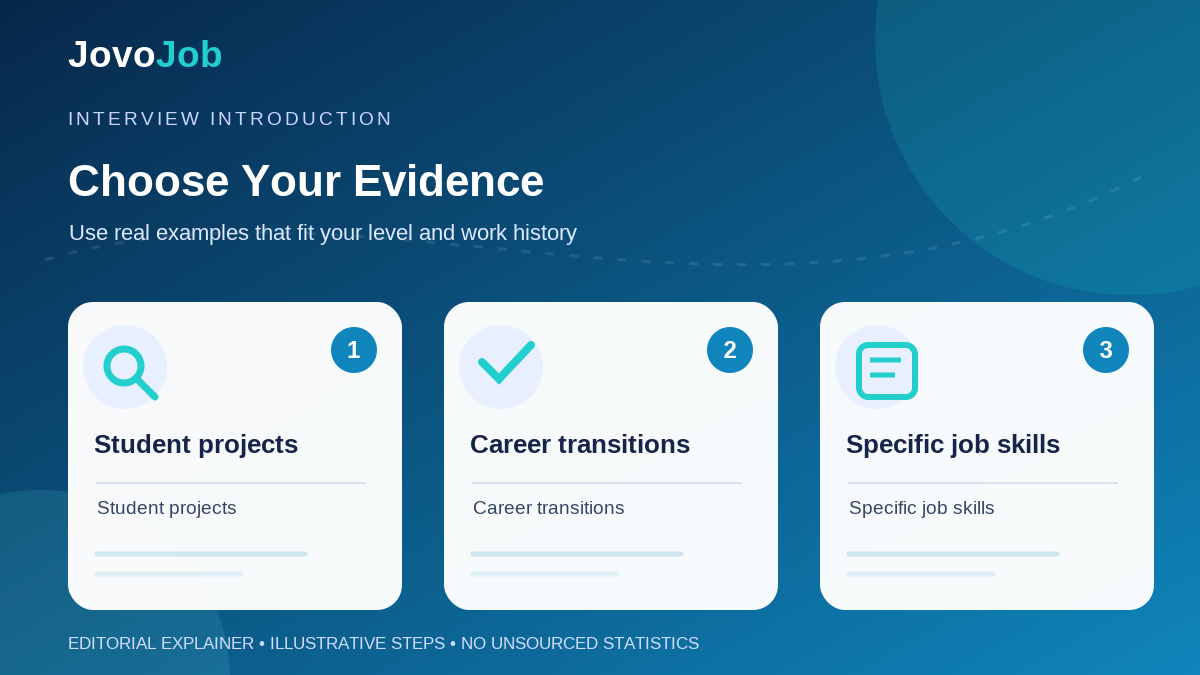
Common mistakes when answering “Tell me about yourself”
- Retelling your whole life: a chronological autobiography hides the job-relevant facts.
- Reading your CV word for word: the interview is an opportunity to interpret your experience, not repeat every bullet.
- Using a generic answer for every role: tailor your strongest example to the actual job requirements.
- Opening with unrelated private details: share personal information only when it serves a purpose you choose.
- Claiming unverifiable results: invented statistics can damage credibility when an interviewer asks follow-up questions.
- Speaking for too long: a concise introduction makes room for the rest of the interview.
- Memorizing a rigid script: rehearsed words can sound unnatural and are harder to adapt to a follow-up.
- Ending without linking to the role: explain why this position is a meaningful next step for you.
Yale's career guidance specifically recommends avoiding a memorized word-for-word story. Think of your answer as three talking points that can be expressed naturally, not a speech you must reproduce perfectly.
Present–Past–Future versus STAR: when should you use each?
For “Tell me about yourself,” use Present–Past–Future or a similar short professional introduction. It helps answer who you are, what you have done and why you are here. For behavior-based questions such as “Tell me about a time you handled a difficult customer,” use STAR: Situation, Task, Action and Result. These questions request a specific example, not a broad introduction.
UW–Madison's interview guide describes STAR for behavioral scenarios, while its general interview advice recommends Present–Past–Future for opening introductions. You can briefly mention an achievement in an introduction and expand it with a STAR story if the interviewer asks you for more detail.
Example transition: “My previous role taught me how to handle customer concerns.” If the next question is “Can you give an example?”, answer with a concrete situation, what you were responsible for, what action you took and the actual outcome.
How to prepare a natural answer in 15 minutes
- Read the job description (3 minutes): identify the two most relevant responsibilities and the qualifications you actually have.
- Choose your present (2 minutes): summarize your current role, study or professional direction in one sentence.
- Choose one past example (3 minutes): select a truthful project or responsibility that shows a relevant skill.
- Write the future connection (2 minutes): explain why this advertised position interests you specifically.
- Practice aloud (3 minutes): speak naturally, then remove unnecessary details and repeated phrases.
- Adjust the tone (2 minutes): create a shorter version for a quick introduction and a longer version if asked to expand.
This is a suggested exercise, not a scientifically tested timing formula. The important point is to rehearse your structure rather than memorize every word. You can use JovoJob Career Agent as one resource to organize job-related preparation, but always check that suggested claims match your actual experience.
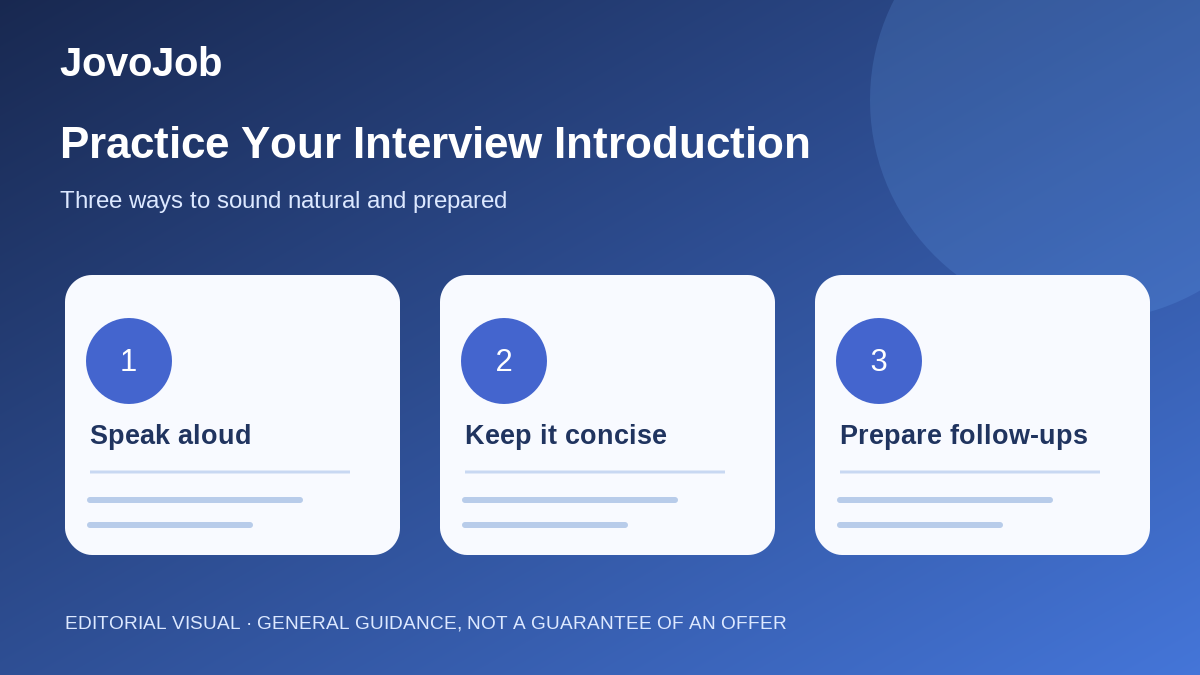
What to say immediately after your introduction
Usually you can stop speaking once you have explained why your skills fit the role. You do not need a dramatic closing line. Leave a natural pause so the interviewer can ask a follow-up. If they invite you to add more, choose an additional project, achievement or detail relevant to the vacancy.
If the discussion develops into behavioral questions, explain real examples. Near the end of the interview, prepare two or three thoughtful questions about the role and team; see our guide to questions to ask an interviewer. After the meeting, a timely, professional thank-you can be appropriate; our follow-up guide
Frequently asked questions
What is the best answer to “Tell me about yourself” in a job interview?
The strongest answer is one that accurately connects your current direction, relevant experience and interest in the advertised role. Use the Present–Past–Future structure as a starting point, but personalize every fact. There is no universal answer that works for all candidates and jobs.
Should I mention my age, family or hobbies?
Usually not in the main professional introduction unless you voluntarily choose a detail that genuinely supports the role. The interviewer is generally asking about your professional background. You can politely keep the conversation focused on skills, work and motivation.
How long should I talk?
About 60–90 seconds is a useful practice target for many interviews; some university career centers recommend keeping it under two minutes. Follow the interviewer's instructions and adjust for the context rather than rigidly timing every word.
Can I use the same answer in every interview?
Keep the structure, but adapt the examples and final sentence for each vacancy. A candidate applying for inventory work should emphasize different responsibilities than one applying for customer support.
What if I am nervous and forget my answer?
Pause briefly, return to your three talking points and continue in your own words. You do not need to apologize for every pause. Practicing several natural variations can be more useful than memorizing a perfect paragraph.
Should I use STAR for “Tell me about yourself”?
STAR is especially useful for questions asking about a specific past situation. Present–Past–Future usually makes a clearer opening introduction. Both approaches can complement each other during the interview.
Can I use AI to write my introduction?
You can use AI to organize ideas or edit wording, but review the result carefully. It should never invent skills, employers, qualifications or achievements. Practice expressing the final version naturally rather than reading a generated script.
Final checklist before your interview
- My introduction begins with a real current role, study or professional direction.
- I include one relevant example that I can describe honestly.
- I identify a skill actually needed in this vacancy.
- I explain why the particular role interests me.
- My answer is concise, clear and comfortable to say out loud.
- I have a shorter version and can expand if the interviewer requests details.
- I am ready with one STAR story for a likely follow-up question.
A confident introduction comes from clarity and preparation, not exaggeration. Read the job posting, pick your strongest relevant facts and practice sounding like yourself. Explore more practical JovoJob career guides for CV writing, applications and interview follow-up.
Sources and editorial notes
This original JovoJob editorial guide was prepared November 10, 2026. The recommendations were cross-checked against Yale University Office of Career Strategy — Tell Me About Yourself, University of Wisconsin–Madison Career Center — Common Interview Questions, Brandeis University — How to Answer Tell Me About Yourself, Mississippi State University Career Center — Prepare for an Interview, and University of Texas at Dallas Career Center — Interviews. All sample candidate statements are fictional, written for demonstration, and are not actual testimonials. Recruitment norms and timing may vary by employer and country. This guide does not guarantee an interview or a job offer.