Resume Analyzer: How to Analyze and Improve Your Resume
A resume can look professional and still fail to communicate your qualifications effectively. You may have the right experience, skills, and education, but if your resume is poorly structured, missing relevant keywords, or too vague, your strongest qualifications may not stand out.
This is where a Resume Analyzer can help.
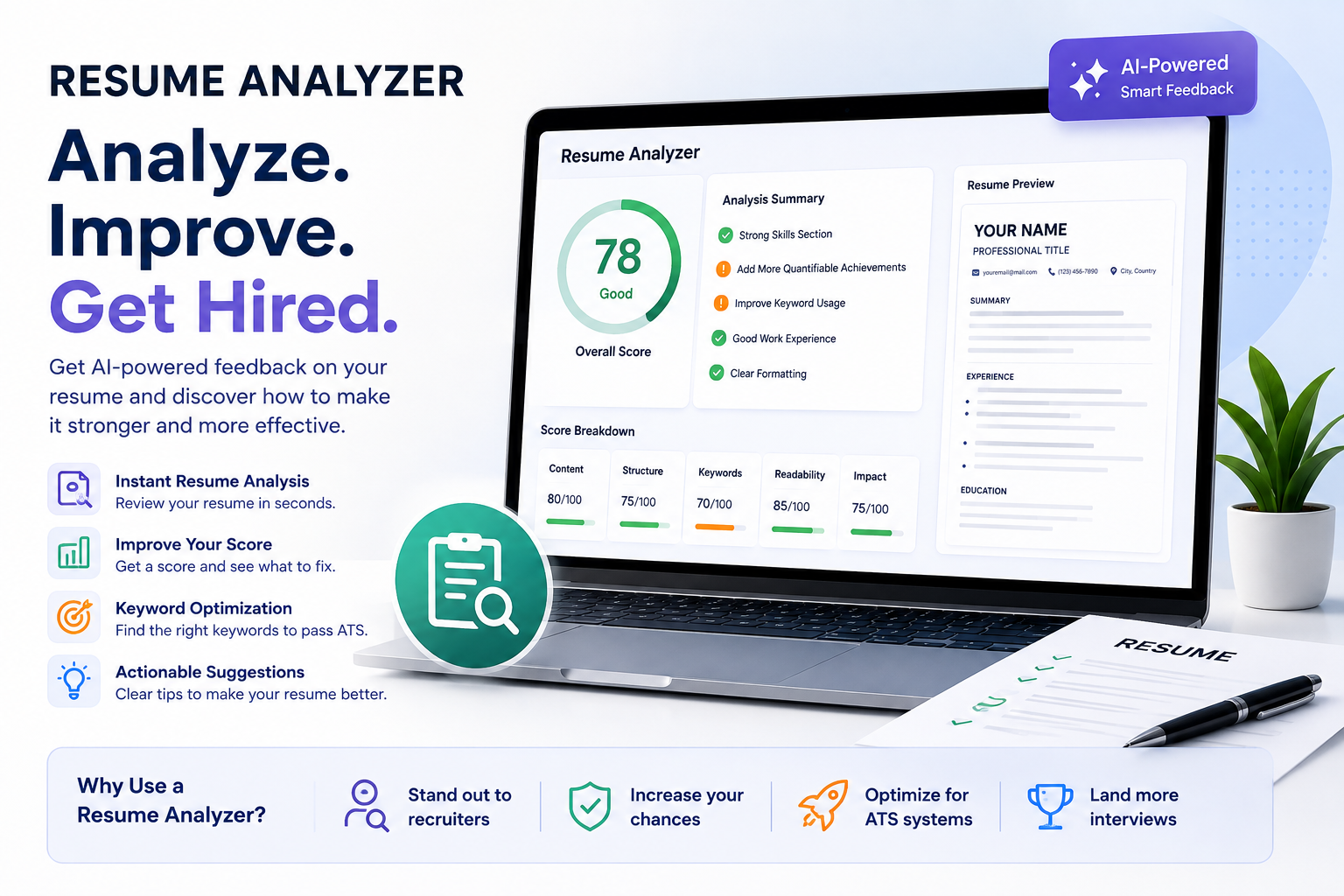
A resume analyzer reviews different parts of your resume and identifies areas that may need improvement. Depending on the tool, the analysis can focus on factors such as resume structure, keywords, skills, experience descriptions, readability, and alignment with a target job.
Instead of guessing whether your resume is strong enough, you can use a resume analysis to identify specific areas that deserve attention before submitting your application.
What Is a Resume Analyzer?
A Resume Analyzer is a tool designed to evaluate the content and structure of a resume and provide feedback that can help job seekers improve it.
A modern AI resume analyzer can examine the information in your resume and highlight potential weaknesses, such as:
- Missing or weak keywords
- Unclear professional summary
- Generic job descriptions
- Skills that are not clearly presented
- Poorly written bullet points
- Missing achievements
- Inconsistent information
- Resume sections that need improvement
The purpose of a resume analyzer is not simply to give you a score. The most useful analysis explains what could be improved and why.
This makes resume analysis especially useful before applying for an important position.
Why Should You Analyze Your Resume?
Many job seekers create a resume once and use the same version for every application.
.
The problem is that different jobs can require different skills, qualifications, and terminology.
For example, a digital marketing position might emphasize SEO, Google Analytics, paid advertising, and content marketing, while a sales position could focus on lead generation, customer relationships, negotiation, and revenue growth.
A resume analyzer can help you identify whether your resume clearly communicates the qualifications that matter for your target position.
Analyzing your resume can therefore help you move from simply having a resume to having a more targeted job application.
What Does a Resume Analyzer Check?
The exact features vary between tools, but a comprehensive resume checker can evaluate several important areas.
Resume Structure
Your resume should have a logical structure that allows recruiters to quickly understand your background.
Common sections include:
- Professional Summary
- Work Experience
- Education
- Skills
- Certifications
- Projects
- Additional Information
A resume analyzer can help identify whether important sections are missing or whether your information could be organized more effectively.
Professional Summary
Your professional summary should quickly communicate who you are professionally and what you bring to an employer.
A weak summary might say:
Hardworking and motivated professional looking for a challenging opportunity.
This statement is generic and does not tell the recruiter much about your actual qualifications.
A stronger summary should mention your professional background, relevant skills, industry, or achievements.
For example:
Digital marketing specialist with three years of experience in SEO, paid advertising, and content strategy, focused on increasing organic traffic and online conversions.
A resume analyzer can help you identify whether your summary is specific enough and relevant to the type of position you want.
Analyze Your Resume Keywords
Keywords are an important part of modern resume optimization.
Employers often describe specific skills, technologies, qualifications, and responsibilities in their job postings. Using relevant terminology in your resume can make your qualifications easier to identify.
For example, a software development job might mention:
- Python
- JavaScript
- React
- SQL
- Git
- REST APIs
If you genuinely have those skills, your resume should communicate them clearly.
However, adding random keywords just to increase a resume score is not a good strategy. Your resume should accurately represent your actual experience.
Check Your Resume for ATS Compatibility
Many job seekers use a Resume Analyzer because they are concerned about Applicant Tracking Systems, commonly called ATS.
An ATS can help employers manage job applications and search candidate information. Because different systems and employers can use different configurations, there is no universal resume score that guarantees an application will pass an ATS.
Instead, focus on making your resume clear and easy to process.
Important considerations include:
- Clear section headings
- Relevant keywords
- Consistent formatting
- Readable text
- Clearly defined job titles
- Easy-to-understand work history
- Accurate skills and qualifications
An ATS-friendly resume should also remain easy for a human recruiter to read.
Improve Your Resume Bullet Points
One of the most common weaknesses in resumes is using generic descriptions of responsibilities.
For example:
Responsible for managing customer accounts.
This tells the recruiter what you did, but not much about your impact.
A stronger version could be:
Managed 50+ customer accounts and improved client retention through regular follow-ups and targeted support.
The second example provides more context and demonstrates the scale of the responsibility.
When analyzing your resume, look for opportunities to transform simple responsibilities into achievement-focused statements.
Try to communicate:
Action + Responsibility + Result
Whenever possible, include measurable information such as:
- Revenue
- Sales
- Number of customers
- Percentage growth
- Time saved
- Projects completed
- Team size
- Conversion rates
Specific evidence can make your experience more convincing.
What Is a Good Resume Score?
Some resume checkers provide a numerical resume score.
A score can be useful as a quick indicator, but it should not be treated as an absolute measure of your chances of getting hired.
Different tools can use different criteria to evaluate a resume. More importantly, employers have different requirements, and a resume that performs well for one position may need significant changes for another.
Instead of asking only:
"What is my resume score?"
ask:
"What can I improve in my resume for this specific job?"
That mindset leads to more useful optimization.
How to Use a Resume Analyzer Effectively
Simply uploading your resume to an analyzer is not enough.
Use the feedback as a checklist for improvement.
Step 1: Upload Your Current Resume
Start with the resume you currently use for job applications.
Do not try to make it perfect before analyzing it. The purpose of the analysis is to discover weaknesses you may not have noticed yourself.
Step 2: Review the Feedback
Look carefully at the recommendations.
Separate them into categories:
- Formatting
- Keywords
- Skills
- Experience
- Summary
- Achievements
- Missing information
This makes the improvement process easier to manage.
Step 3: Make Real Improvements
Do not change your resume simply to increase a numerical score.
If the analyzer suggests adding a skill you do not possess, do not add it.
Instead, focus on accurately presenting your real experience in a clearer and more relevant way.
Step 4: Analyze the Resume Again
After making significant changes, run another resume analysis.
Compare the new feedback with the previous version.
This creates an improvement cycle:
Analyze → Improve → Reanalyze → Apply
Resume Analyzer vs. Resume Builder
A Resume Builder and a Resume Analyzer serve different purposes.
A Resume Builder helps you create and organize your resume.
A Resume Analyzer helps you evaluate and improve an existing resume.
You can therefore use both tools as part of the same workflow.
First, create your resume using the JovoJob Resume Builder.
Then analyze the finished document using the JovoJob Resume Analyzer to identify areas that could be improved.
This creates a simple process:
Build → Analyze → Improve → Apply
Use JovoJob to Analyze Your Resume
If you already have a resume and want to understand where it can be improved, try the JovoJob Resume Analyzer.
Instead of relying only on your own judgment, a resume analysis can help you review your document from multiple perspectives, including content, keywords, structure, and overall effectiveness.
After reviewing the feedback, make the necessary improvements and create a stronger version of your resume.
The goal isn't to create a resume that looks perfect according to a generic score. The goal is to create a resume that accurately presents your qualifications and is relevant to the jobs you are targeting.
Common Resume Problems an Analyzer Can Help Identify
Before submitting your resume, look for these common issues:
- Generic professional summaries
- Missing keywords
- Long paragraphs
- Weak bullet points
- Responsibilities without achievements
- Irrelevant information
- Unclear job titles
- Missing skills
- Inconsistent formatting
- Spelling or grammar mistakes
- Poor alignment with the target position
Fixing several small problems can make your resume substantially clearer and more targeted.
Should You Analyze Your Resume Before Every Job Application?
You do not necessarily need to completely rewrite your resume for every position.
However, reviewing your resume against the requirements of each important job can be useful.
Pay particular attention to:
Job title: Does your experience clearly relate to the position?
Keywords: Have you naturally included relevant terminology that accurately describes your skills?
Experience: Are your most relevant achievements easy to find?
Skills: Are the skills most important for the position clearly presented?
Summary: Does your introduction match the type of role you're applying for?
This approach allows you to maintain a strong master resume while making targeted adjustments for specific opportunities.
Final Resume Analysis Checklist
Before sending your application, ask yourself:
- Is my resume easy to read?
- Does my professional summary clearly describe my background?
- Are my most relevant skills easy to find?
- Have I included relevant keywords naturally?
- Do my bullet points demonstrate achievements?
- Have I removed unnecessary information?
- Is my work history clearly organized?
- Does my resume accurately represent my experience?
- Have I checked the resume against the job description?
- Have I reviewed the final version for errors?
If you can answer yes to these questions, your resume is likely in a much stronger position than when you started.
Conclusion: Analyze Your Resume Before You Apply
Creating a resume is only the first step. Reviewing and improving it can help you present your experience more clearly and make your application more relevant to the position you're targeting.
A Resume Analyzer can help identify weaknesses in your resume, from missing keywords and vague descriptions to structural and formatting issues.
The most important thing is to use the feedback intelligently. Don't add information you don't have simply to improve a score. Instead, use the analysis to communicate your real qualifications more effectively.
If you already have a resume, start with the JovoJob Resume Analyzer, review the recommendations, make the necessary improvements, and prepare a stronger application for your next opportunity.
Advertisement
Google AdSense space reserved for this article.