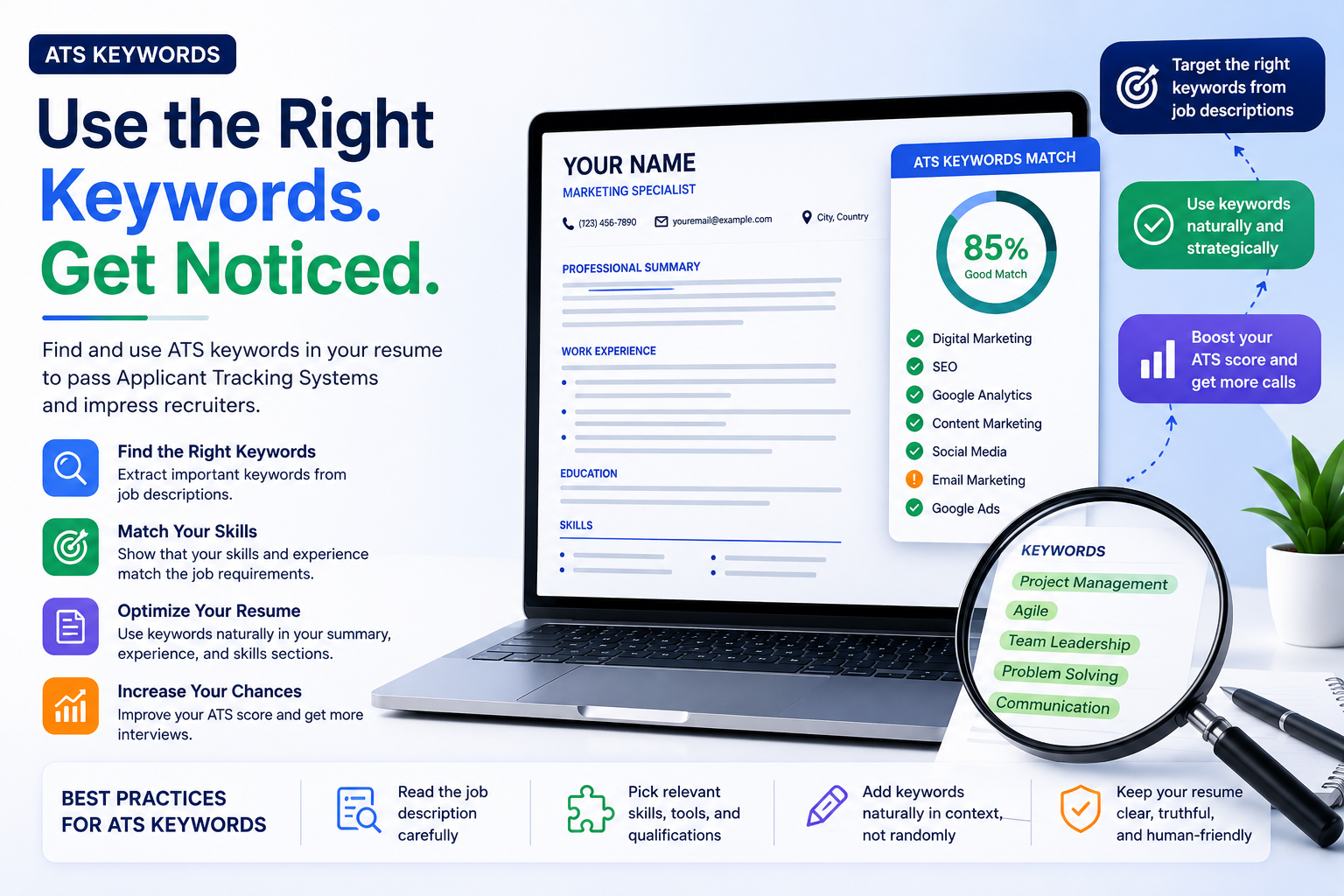
ATS Keywords: How to Find and Use the Right Keywords in Your Resume
When you apply for a job online, your resume may be reviewed by more than just a recruiter. Many employers use Applicant Tracking Systems (ATS) to organize applications and search resumes for information related to a position.
This makes ATS keywords an important part of modern resume writing. The right keywords can help you communicate your skills, experience, and qualifications more clearly while making your resume more relevant to the job you want.
However, adding keywords randomly is not the right approach. Effective resume optimization means identifying the terminology used in the job description and incorporating relevant terms naturally throughout your resume.
In this guide, you'll learn what ATS keywords are, how to find them, where to use them, and which mistakes you should avoid when optimizing your resume.
What Are ATS Keywords?
ATS keywords are words and phrases related to the skills, qualifications, experience, tools, responsibilities, and requirements associated with a particular job.
For example, a digital marketing job description might mention keywords such as:
- Search Engine Optimization (SEO)
- Google Analytics
- Content Marketing
- Google Ads
- Keyword Research
- Email Marketing
- Social Media Marketing
If you genuinely have these skills, using the relevant terminology in your resume can make your qualifications clearer and more closely aligned with the position.
ATS keywords are therefore not simply words added to increase a score. They should accurately describe your professional background and demonstrate how your experience relates to the job.
Why Are ATS Keywords Important?
Employers can receive a large number of applications for a single position. Applicant Tracking Systems can help organizations manage those applications and search candidate information.
When a job description emphasizes specific skills or qualifications, using the same relevant terminology in your resume can make it easier to identify the connection between your background and the position.
For example, if a job requires experience with project management, Agile, Scrum, Jira, and stakeholder communication, a candidate who genuinely has those skills should make them clearly visible in the resume.
This does not mean that every resume needs to contain every word from the job description. The goal is to create a resume that accurately reflects your experience while being relevant to the position.
How to Find ATS Keywords in a Job Description
The easiest way to find ATS keywords for your resume is to start with the job description itself.
Read the entire job posting and identify words or phrases that describe the candidate the employer is looking for.
Look for Required Skills
Pay attention to technical and professional skills mentioned in the job description.
For example, a software developer position might require:
- Python
- JavaScript
- React
- SQL
- Git
- REST APIs
If you have these skills, make sure they are clearly represented in your resume.
Look for Job-Specific Qualifications
Some keywords are related to qualifications rather than technical skills.
These may include:
- Bachelor's degree
- Project management certification
- Five years of experience
- Customer service experience
- Leadership experience
- Sales management
Only include qualifications that you actually possess. Never add a certification, degree, skill, or experience simply because it appears in a job description.
Look for Tools and Technologies
Software, platforms, technologies, and tools are often important resume keywords.
Depending on the industry, examples could include:
- Microsoft Excel
- Salesforce
- HubSpot
- Adobe Photoshop
- Figma
- Shopify
- WordPress
- Google Ads
If you have practical experience with a tool mentioned by the employer, consider including it in the relevant section of your resume.
Where Should You Put ATS Keywords on Your Resume?
Finding the right keywords is only half of the process. You also need to place them naturally throughout your resume.
Professional Summary
Your professional summary is one of the first sections recruiters see, so it can be a useful place to introduce your most relevant skills and professional terminology.
For example:
Digital marketing specialist with three years of experience in SEO, content marketing, Google Analytics, and paid advertising.
This summary communicates several relevant keywords while still sounding natural.
Work Experience
Your work experience section is one of the most important places to use ATS resume keywords.
Instead of simply listing responsibilities, explain what you did and how you used your skills.
For example:
Managed Google Ads campaigns and optimized landing pages to improve lead generation and conversion performance.
This example naturally incorporates terms such as Google Ads, landing pages, lead generation, and conversion performance.
Skills Section
Your skills section provides a simple way to highlight relevant qualifications.
For example:
- SEO
- Google Analytics
- Content Marketing
- Google Ads
- Email Marketing
- Keyword Research
However, your skills section should support the experience described elsewhere in your resume. If you list a skill, be prepared to demonstrate how you have actually used it.
Certifications and Education
Relevant certifications, degrees, and professional qualifications can also contain important keywords.
If a job requires a specific certification that you possess, use the official name of the certification rather than an unclear abbreviation alone.
Use the Exact Terminology When It Is Relevant
When optimizing your resume, pay attention to the terminology used by the employer.
For example, if the job description uses the term Search Engine Optimization (SEO), you can use both the full term and the abbreviation where appropriate.
This can make your resume clearer for both automated systems and human readers.
The same principle can apply to job titles, software names, certifications, technical skills, and industry terminology.
However, don't change your actual job title to something you never held simply because another title appears in the job description. Your resume should remain truthful and accurate.
Don't Stuff Your Resume With Keywords
One of the biggest mistakes in resume optimization is keyword stuffing.
Keyword stuffing means adding the same terms repeatedly or inserting keywords in places where they do not naturally belong.
For example, a sentence such as:
SEO specialist with SEO skills, SEO experience, SEO knowledge, SEO strategy, and SEO expertise.
does not create a professional resume.
A better approach is to describe your actual experience:
Optimized website content and technical SEO elements to improve organic search visibility and increase qualified traffic.
The second example communicates relevant SEO terminology while remaining useful and readable.
Match Your Resume to Each Job
There is no single list of ATS keywords that works for every job.
A marketing manager, software developer, financial analyst, and customer service representative will need different terminology.
This is why your resume should be tailored to the specific position you are applying for.
You do not need to completely rewrite your resume every time. Instead, maintain a strong master resume and adjust the following areas when appropriate:
- Professional summary
- Relevant skills
- Work experience bullet points
- Projects
- Certifications
- Job-specific terminology
This allows you to create a more relevant application without starting from zero for every job.
ATS Keywords vs. Regular Resume Keywords
There is not necessarily a completely separate category of words called "ATS keywords." In practice, the phrase usually refers to relevant words and phrases from a job description that can help describe a candidate's qualifications in a way that aligns with the position.
For example, if an employer is looking for a customer service representative with experience in CRM software, customer retention, conflict resolution, and sales support, those terms may be relevant resume keywords for that particular application.
The important factor is relevance.
Your resume should use terminology that accurately reflects your background and connects your experience to the employer's requirements.
How an ATS Keywords Tool Can Help
Finding relevant keywords manually can take time, especially when job descriptions are long or contain many requirements.
An ATS keywords tool can help you identify important terms and compare them with the content of your resume.
Instead of reading the job description repeatedly and trying to identify every important phrase yourself, a dedicated tool can give you a more structured starting point for resume optimization.
You can use the JovoJob ATS Keywords Tool to help identify relevant keywords and improve the alignment between your resume and the position you're targeting.
How to Optimize Your Resume With ATS Keywords
A simple keyword optimization workflow can look like this:
- Find a job you want to apply for.
- Read the job description carefully.
- Identify important skills, qualifications, tools, and terminology.
- Compare those terms with your existing resume.
- Keep the keywords that accurately describe your experience.
- Add relevant terms naturally to your summary, experience, and skills.
- Remove unnecessary repetition.
- Review the final resume for readability and accuracy.
This process helps you create a resume that is more targeted without turning it into a list of keywords.
Common ATS Keyword Mistakes to Avoid
When optimizing your resume, avoid these common mistakes:
- Adding skills you do not have
- Repeating the same keyword excessively
- Copying the entire job description into your resume
- Using keywords that are unrelated to your experience
- Ignoring important skills mentioned in the job posting
- Using unclear abbreviations instead of recognizable terminology
- Focusing only on keywords while ignoring achievements
- Making the resume difficult for humans to read
Your keywords should support your professional story, not replace it.
Use ATS Keywords With Achievements
The strongest resumes do more than list skills. They demonstrate how those skills were used.
Compare these two examples:
Basic:
Google Ads, SEO, and content marketing.
Stronger:
Managed Google Ads campaigns, optimized SEO content, and developed content marketing strategies to increase qualified website traffic.
The second version places relevant keywords inside a real description of professional activity.
Whenever possible, combine your keywords with responsibilities, actions, and measurable results.
Check Your Resume After Adding Keywords
Adding keywords should not be the final step.
Read your entire resume again and ask yourself:
- Does it still sound natural?
- Are the keywords relevant to my experience?
- Have I included the most important skills from the job description?
- Are my achievements clearly explained?
- Is the resume easy for a recruiter to scan?
- Have I repeated any keyword unnecessarily?
- Does every qualification accurately describe me?
If the answer to these questions is yes, your resume is more likely to provide a clear and relevant picture of your qualifications.
Build, Analyze, and Optimize Your Resume
ATS keyword optimization works best as part of a broader resume improvement process.
You can start by creating your resume with the JovoJob Resume Builder.
After creating your resume, use the JovoJob Resume Analyzer to review your resume and identify areas that may need improvement.
Next, use the JovoJob ATS Keywords Tool to identify relevant keywords from the job description and improve the alignment between your resume and the position.
If you also need a professional cover letter for the same application, you can create one with the JovoJob Cover Letter Generator.
A complete job application workflow can therefore look like this:
Build → Analyze → Find Keywords → Optimize → Create Cover Letter → Apply
Final ATS Keywords Checklist
Before submitting your resume, make sure you have:
- Read the complete job description.
- Identified the most relevant skills and qualifications.
- Included keywords that genuinely match your experience.
- Used relevant terminology in your professional summary.
- Included important keywords naturally in your work experience.
- Listed relevant skills clearly.
- Used official names for relevant tools and certifications.
- Avoided keyword stuffing.
- Focused on achievements rather than keywords alone.
- Reviewed your resume for accuracy and readability.
Conclusion: Use ATS Keywords the Right Way
ATS keywords can play an important role in creating a targeted resume. The key is not to add as many keywords as possible, but to identify the terminology that genuinely describes the position and then use those terms naturally throughout your resume.
Start with the job description, identify the skills and qualifications that matter, and connect those requirements to your real professional experience.
When keywords are combined with clear formatting, strong achievements, relevant skills, and accurate information, they can help you create a more focused and effective job application.
Ready to optimize your resume? Try the JovoJob ATS Keywords Tool to find relevant keywords and make your resume more closely aligned with the jobs you're targeting.
Once your resume is optimized, you can review it again with the JovoJob Resume Analyzer and prepare a matching cover letter using the JovoJob Cover Letter Generator.
Advertisement
Google AdSense space reserved for this article.